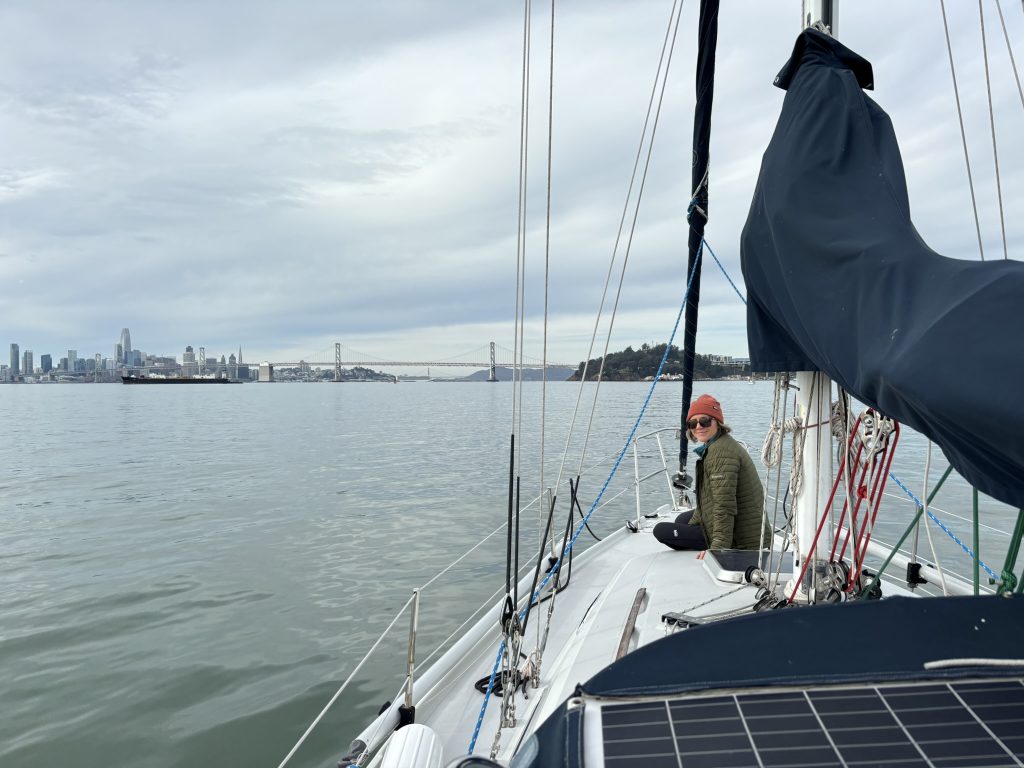
Date: November 14, 2025
Crew: Jeremyn + Becca
Time Underway: ~6 hours
Route: Grand Marina → Oakland Estuary → Yerba Buena Island → San Francisco Bay → return
1. Departure & Systems Check
We cast off from Grand Marina at 11:15, conducting a slow-speed systems check down the Oakland Estuary.
- Engine: Warmed up normally.
- Tachometer: Initially dead, later displayed erratic readings above 2500 RPM. Based on boat speed (5–6 knots), the true RPM was significantly lower.
- Controls: Throttle and shift cables functional but stiff.
- Steering / Autopilot: Steering felt solid; autopilot powered on normally.
2. Transit Down the Estuary
We motored at ~3 knots to evaluate propulsion behavior—vibration, helm feel, and responsiveness in tight quarters. Traffic was moderate, with tugs and freighters moving through the channel.
Time to the estuary mouth: ~1 hour.
3. Under Sail — Rounding Yerba Buena Island
East of Yerba Buena Island, the breeze filled enough for sail testing.
- Hoisted main, then jib.
- Sailed northwest toward the Golden Gate.
- Boat balance felt predictable and steady.
- Raymarine instruments performed well.
We sailed until ~14:30, then turned back to ensure daylight and avoid incoming rain.
4. Return Toward Bay Bridge — Traffic Avoidance
On the downwind run toward the Bay Bridge, a large tanker with two tugs closed on us faster than expected.
- Powered up the engine
- Dropped sails early
- Cleared the channel proactively
This reinforced the importance of monitoring VHF CH 13 near restricted-maneuverability vessels and heavy commercial lanes.
5. Autopilot Exercise
Once clear of traffic, we tested the wheel-mounted autopilot.
- Initial “No Data” errors resolved once underway on engine
- Unit held a steady course
- Heading sensor calibration will be required for consistent performance
6. Approach & Docking
We arrived back at the Grand Marina fairway around 17:00, just before dark.
- Approach executed at idle with gentle helm movements
- Neutral coasting provided good control
- Docking was successful
A brief bow drift toward a piling occurred when stepping off the stern, but quick correction prevented contact. A pre-rigged midship spring will improve future approaches. After securing lines and fenders, I noted the flag halyard was left uncleated, though no issues resulted.
7. Condition Notes & Action Items
- Tachometer unreliable
→ Inspect alternator excitation circuit and grounding. - Throttle & shift cables stiff
→ Replacement already planned. - Autopilot requires calibration
→ Perform dockside and underway calibration sequence. - Traffic monitoring
→ Maintain watch on VHF CH 13/14 near Bay Bridge/YBI. - Docking preparation
→ Rig a midship spring before entering slip. - Rigging check on shutdown
→ Confirm halyards and topping lift are secured before leaving the boat.
Summary
This first full outing under my command served as an excellent shakedown for the Ericson 32-200. The boat performed reliably:
- Engine ran smoothly
- Sails handled predictably
- Steering and systems responded as expected
A few minor issues surfaced—typical for a newly acquired older vessel—but the day validated the boat’s condition and confirmed the priority list for upcoming improvements.
A successful first voyage, and a solid foundation for future offshore preparation.
—J